
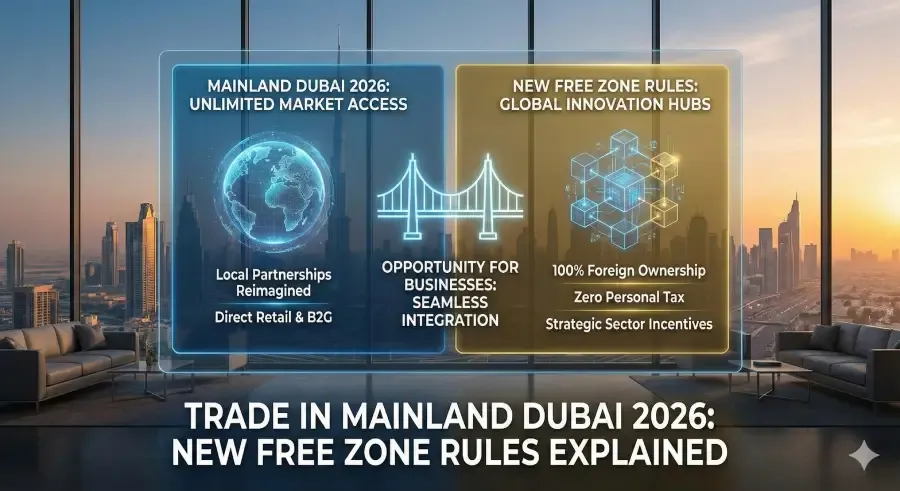
Trade in Mainland Dubai 2026: New Free Zone Rules Explained
Dubai’s 2026 economy is built for expansion—new market access reforms, streamlined licensing, and a strong push under Dubai’s D33 agenda to grow trade and attract global companies. But the biggest shift many entrepreneurs still haven’t fully understood is this:
Trade in Mainland Dubai 2026 is no longer only a “mainland company privilege.”
Free Zone companies—once restricted from directly operating onshore—now have legal pathways to access the mainland market through new Dubai DET frameworks introduced in 2025 and strengthened in 2026. If you’re an entrepreneur, NRI investor, or SME planning expansion, this is one of the most practical opportunities available right now.
At Wings9, we’re already helping Free Zone companies scale into Dubai mainland using the correct permit/branch strategy—without triggering compliance risks, banking problems, or tax surprises.
Quick Answer
Trade in Mainland Dubai 2026 is possible for Free Zone companies through Dubai DET’s mainland access framework, including the Free Zone Mainland Operating Permit and structured licensing/branch options. This allows eligible Free Zone businesses to offer services or expand operations onshore legally, without creating a new mainland entity in many cases.
What Changed? The New Free Zone Rules Dubai 2026.
Before 2025, the mainland market was restricted for Free Zone companies. Businesses had to rely on:
local distributors
commercial agents
or a separate mainland entity
That meant extra cost, fragmented invoicing, and lower margins.
But in March 2025, Dubai introduced a major reform via Executive Council Resolution No. 11 of 2025, enabling many Free Zone establishments to conduct business activities on the mainland through Dubai DET licensing/permits.
Then, in October 2025, Dubai DET launched a formal Free Zone Mainland Operating Permit—a practical route allowing Free Zone companies to legally operate onshore under specific conditions.
This reform is exactly why Trade in Mainland Dubai 2026 is a high-opportunity topic.
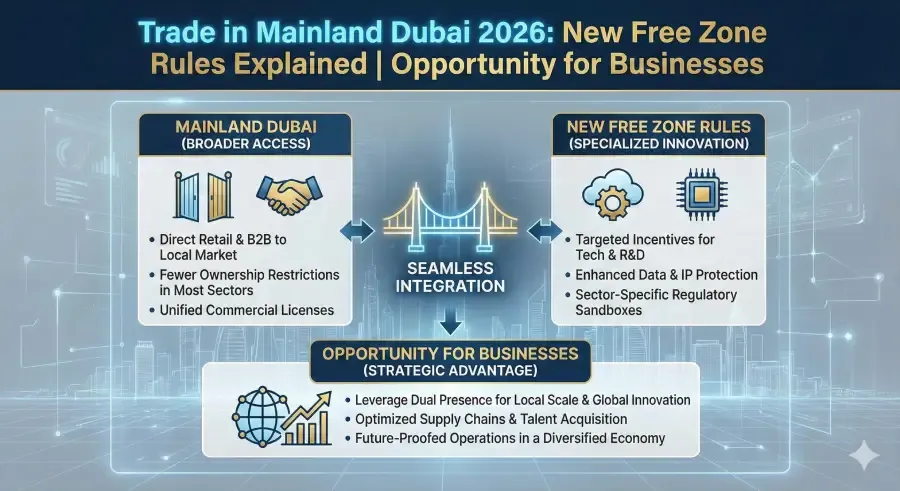
Why Dubai Is Doing This (And Why It Matters for You)
Dubai’s policy direction is clear:
reduce friction for investors
unify commercial ecosystems
grow trade velocity
What this means for business owners:
✅ You can expand faster
✅ You can invoice UAE clients more directly
✅ You can unlock larger contracts
✅ You can reduce reliance on intermediaries
In short, the opportunity for businesses in Dubai is shifting from “setup-based advantage” to “market access advantage.”
Can Free Zone Companies Trade in Mainland Dubai in 2026?
Yes—but only through approved routes.
And this is where many companies get confused (or misled by low-cost agents).
In 2026, Free Zone companies can legally access mainland through:
Free Zone Mainland Operating Permit (DET)
Branch / Representative office on mainland
Dual licensing model (where permitted)
Distributor/agent model (still valid in some trading cases)
Gulf News confirms new rules allowing free zone and financial free zone companies to set up branches/representative offices onshore, subject to approvals.
The 4 Legal Ways to Access Mainland Market in 2026
1) Free Zone Mainland Operating Permit (Dubai DET)
Dubai DET introduced this permit to allow Free Zone companies to operate in mainland under a defined framework.
Key details:
Valid for 6 months
Cost: AED 5,000
Renewable every six months at the same fee
Best for:
Consultancies, professional services, tech firms, agencies, project-based businesses.
Wings9 Insight: This permit is powerful—but not universal. Activity approvals matter. One mismatch and your mainland expansion gets blocked.
2) Mainland Branch / Representative Office
Instead of forming a fresh mainland entity, eligible Free Zone companies can open:
an onshore branch, or
representative office
This is ideal for:
servicing UAE clients
hiring local teams
operating warehouses/field work
This route is repeatedly mentioned as a compliant pathway under the new reform environment.
3) Dual License Dubai (Where Applicable)
Some Free Zones allow dual licensing arrangements, letting a Free Zone entity provide certain services in mainland without creating a separate company.
Best for:
Service businesses with structured Free Zone ecosystems.
But here’s the catch:
Dual licensing isn’t universal. Every Free Zone has its own policy limits. This is exactly why Wings9 runs a jurisdiction feasibility check before any client chooses this path.
4) Distributor / Commercial Agent Model (Still Relevant)
For product-heavy businesses:
imports
wholesale
retail
Often, the distributor model remains operationally practical.
But it reduces:
margin
control
customer ownership
This is why the 2026 reform is huge: it gives founders options beyond intermediaries.
Trade in Mainland Dubai 2026: Mainland vs Free Zone Expansion
A key misconception:
“If I’m Free Zone, I must convert to Mainland to sell locally.”
Not always.
In 2026, many businesses can:
Keep Free Zone benefits
But access mainland via a permit/branch strategy
Mainland vs Free Zone Dubai: Expansion Comparison
Area | Mainland Company | Free Zone + Mainland Access |
|---|---|---|
UAE Market Access | Direct | Via permit/branch |
Setup Speed | Moderate | Fast (if already licensed) |
Compliance | Standard | Additional alignment required |
Banking | Easier for UAE revenue | Strong if documentation clean |
Tax planning | Straightforward | Must track income sources |
This is a new-era strategy for Dubai business setup 2026.
What Activities Are Allowed for Mainland Access?
Dubai DET typically allows mainland access based on:
approved activity list
permit conditions
operational substance
Many advisors oversimplify this. In reality:
✅ Professional activities are generally smoother
⚠️ pure trading/retail has stricter requirements
Pro Tip (Wings9 Shortcut):
Before you apply for any mainland permit, we check whether your Free Zone licence activity matches DET’s approved onshore activity mapping. This avoids rejection + delays.
Corporate Tax UAE 2026: What Changes When You Trade Mainland?
This is where CFOs and investors must pay attention.
If you’re a Free Zone company enjoying potential tax benefits, you must keep income classification clean:
qualifying income vs non-qualifying income
related party transactions
mainland-sourced revenue
If handled wrong, mainland revenue can:
affect Free Zone tax positioning
increase compliance burden
create audit triggers
This is why Economic Substance Regulations UAE and tax reporting alignment matter more in 2026 than ever.
Real Opportunity: Why This Reform Is a Profit Accelerator
Here’s what we see from client expansions at Wings9:
Mainland access helps you:
close UAE deals faster (no agent/distributor delays)
bill UAE corporates confidently
bid for more local projects
build long-term contracts
increase valuation (clean revenue geography)
So Trade in Mainland Dubai 2026 is not only compliance—it's commercial strategy.
Step-by-Step: How to Expand From Free Zone to Mainland (Wings9 Framework)
This is the exact operational checklist we follow:
Step 1: Confirm eligibility
Free Zone type
activity classification
shareholder structure
Step 2: Choose the correct route
permit vs branch vs dual licence
Step 3: Obtain NOC (if required)
Many free zones require NOC before expansion.
Step 4: Submit DET application
Include:
licence copy
office details (if applicable)
manager documents
compliance declarations
Step 5: Activate operations
onshore contracts
Staff visa alignment
accounting separation for income streams
Featured Snippet Table: Permit vs Branch vs Mainland Company
Option | Best For | Speed | Cost | Key Risk |
|---|---|---|---|---|
DET Mainland Operating Permit | Service + project businesses | High | Low | Activity limitations |
Mainland Branch | Scaling UAE operations | Medium | Medium | Office + compliance |
Dual Licence | Select Free Zone setups | Medium | Medium | Depends on Free Zone policy |
New Mainland Company | Full UAE market footprint | Medium | High | Higher initial overhead |
FAQ
1) Can Free Zone companies trade in mainland Dubai in 2026?
Yes. Under Dubai’s updated framework, Free Zone companies can access mainland markets through DET permits or branch licensing, subject to approvals.
2) What is the Free Zone Mainland Operating Permit?
It’s a Dubai DET permit allowing eligible Free Zone companies to operate on the mainland. It is valid for six months and costs AED 5,000, renewable every six months.
3) Is dual license available for all Free Zones?
No. Dual licensing depends on the Free Zone authority and activity. Some Free Zones offer it for services; others don’t.
4) Do Free Zone companies need to open a mainland company to sell locally?
Not always. Many can use the DET permit or open a branch/representative office instead of forming a new mainland company.
5) Does mainland access affect Free Zone tax benefits?
It can. Mainland revenue must be tracked properly. Incorrect structuring can trigger tax exposure or compliance issues under UAE corporate tax rules.
6) What is the best option for consultants and service businesses?
For most service businesses, the DET Mainland Operating Permit is the fastest and most cost-efficient route—if activity mapping is correct.
7) How Wings9 helps with this process?
We handle eligibility checks, NOC coordination, DET permit/branch processing, visa alignment, and compliance planning to ensure expansion is smooth and bank-ready.
Pillar Page Integration
If you're still deciding your base structure before expansion, this is your anchor guide:
👉 https://wings9.ae/company-formation-in-dubai-2026-mainland-vs-free-zone/
This article is designed as a high-intent sub-topic under that pillar—especially for founders aiming to enter the mainland market strategically.
Wings9 2026 Outlook (Unique Takeaway)
Here’s our 2026 prediction that most competitors aren’t discussing yet:
In 2026, mainland access becomes the new Free Zone advantage.
Why? Because investors no longer want “either-or.” They want:
Free Zone efficiency
mainland revenue access
tax + banking readiness
scalable visa pathways
We expect more businesses will adopt hybrid expansion models—keeping Free Zone structures while using DET permits/branches to build mainland revenue.
That’s exactly where Wings9 operates best: strategy + paperwork + execution—end-to-end.
Ready to expand into Dubai mainland legally?
We at Wings9 help you evaluate the best route (Permit vs Branch vs Mainland Company), complete approvals, set up visas, and ensure compliance.
Start your Dubai journey with Wings9.