
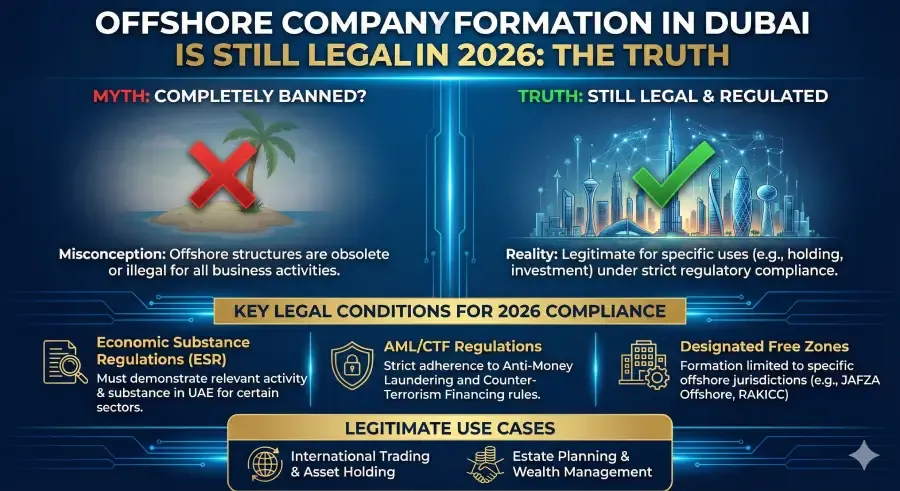
Offshore Company Formation in Dubai Is Still Legal in 2026 (The Truth)
Dubai’s business ecosystem keeps evolving—corporate tax maturity, tighter banking compliance, and global rules like OECD Pillar Two are reshaping how investors structure companies in 2026. That’s exactly why one question is trending again among NRIs, HNIs, and international entrepreneurs:
Is offshore company formation in Dubai still legal in 2026?
Yes—offshore company formation in Dubai is still legal in 2026. But the bigger truth is this: offshore is no longer the “mystery shortcut” that many agents sell. It’s a specific legal structure designed for asset holding, international investments, and structured ownership—not for day-to-day trading inside the UAE.
At Wings9, we explain offshore the way it should be explained—no hype, no confusion, just real strategy.
Quick Answer
Offshore company formation in Dubai is still legal in 2026 and remains useful for asset holding, international business ownership, and confidentiality-led structuring. However, offshore companies cannot directly trade within the UAE mainland and must comply with UAE regulations, including beneficial ownership (UBO) and banking requirements, especially under the post-2024 corporate tax era.
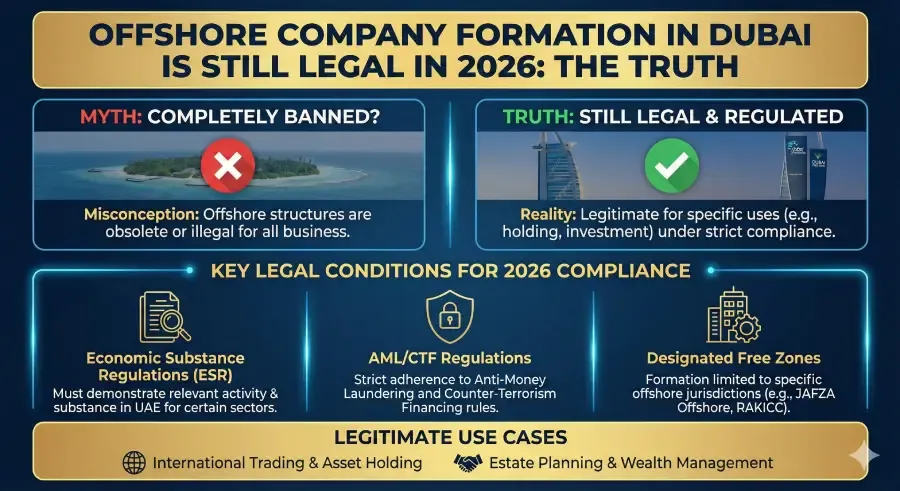
Why Offshore Is Back in the Spotlight in 2026
In 2026, investors are more cautious—and smarter.
Key reasons offshore structures are being reconsidered:
UAE corporate tax rules are now fully operational
OECD Pillar Two compliance is impacting global groups
Banking due diligence is stricter for all jurisdictions
HNIs want clean asset separation and risk protection
This is why “Dubai offshore company 2026” searches are rising. People want legal protection and flexibility—without triggering unexpected tax exposure.
Offshore Company = Legal. But Not “Free Money”
Let’s clear a major misconception upfront:
Offshore company formation in Dubai is not illegal.
But offshore is also not meant to run a shop, trade locally, or hire staff like a regular UAE business.
Offshore companies are governed under specific registries and frameworks (typically through registered agents) and are structured mainly for:
ownership holding
investment structuring
overseas invoicing (outside UAE)
property holding (in specific cases)
For example, JAFZA Offshore registration must be processed through JAFZA Registered Agents.
What Is an Offshore Company in Dubai?
An offshore company in the UAE is a non-resident corporate entity (often called an International Business Company / IBC), typically used for:
Holding assets (shares, real estate, IP)
Owning UAE or foreign subsidiaries
Structuring international trading (outside UAE)
Wealth planning and inheritance structuring
Important: Offshore is NOT the same as Free Zone
Many founders confuse the two.
A Free Zone company can run business operations
An offshore company is primarily an ownership/holding vehicle
This distinction decides whether offshore is right for you.
Is Offshore Company Legal in Dubai? (2026 Reality)
Yes—is offshore company legal in Dubai is not even a debate. It is legal, structured, and widely used.
But it must be used legally.
That means:
legitimate ownership disclosure
real activity alignment
bank compliance readiness
correct jurisdiction selection (RAK ICC vs JAFZA, etc.)
And this is the Wings9 difference: we focus on legal fit + future-proof structure, not “fast registration only.”
Key Offshore Jurisdictions Used for Dubai Structures
In 2026, these remain the most common offshore jurisdictions used for Dubai-linked structuring:
1) JAFZA Offshore (Dubai)
Often chosen for:
Dubai-centric asset holding
property holding in designated cases
stronger Dubai brand perception
Legal guidance confirms JAFZ offshore companies are issued a certificate of incorporation (not a commercial licence) and generally cannot conduct business with persons in the UAE.
Also, Dubai Trade hosts registration workflows for JAFZA registered agents handling offshore companies.
2) RAK ICC Offshore (Ras Al Khaimah)
RAK ICC is one of the most structured registries, established under Emiri Decree No. 12 of 2015.
Common uses:
holding company structures
International investment ownership
cost-effective IBC formation
Offshore Company vs Free Zone Company (2026 Comparison)
Here’s the comparison most investors want—clean and direct.
Feature | Offshore Company | Free Zone Company |
|---|---|---|
Can trade in UAE mainland? | ❌ No | ⚠️ Limited / structure needed |
Can do business internationally? | ✅ Yes | ✅ Yes |
Gets UAE residence visa? | ❌ No | ✅ Yes |
Requires office lease? | ❌ No | ✅ Sometimes |
Best use | Holding / asset protection | Operations / service / trading |
Corporate tax compliance | Depends on activity & structure | Required (even for 0% scenarios) |
This table is where most prospects immediately see the truth: offshore is not a replacement for operating businesses.
Offshore Company Benefits in Dubai (2026)
Used correctly, offshore still delivers strong value.
✅ 1) Asset Protection & Ring-Fencing
Offshore lets you separate:
business operations risk
asset ownership
This is critical for HNIs and family offices.
✅ 2) International Holding Structure
Offshore companies are ideal for:
owning shares in UAE companies
structuring cross-border investments
protecting shareholder confidentiality (within legal frameworks)
✅ 3) No Visa = Fewer Operational Burdens
For pure holding, the absence of visas is not a weakness—it’s efficiency:
no labour file
no quota planning
fewer HR costs
✅ 4) Strategic for Real Estate Holding (Case-Based)
Some offshore structures are used for holding properties (subject to current rules and eligibility conditions).
Certain advisory guides note JAFZA Offshore is often used for property ownership in designated areas.
Wings9 advisory note: Always verify eligibility before purchasing. Property holding compliance in Dubai is document-heavy—done wrong, it delays transfer.
Offshore Company Compliance UAE: What You Must Follow
This is where “2026 reality” hits.
In 2026, offshore companies must still maintain compliance with:
UBO disclosures
AML checks
banking KYC requirements
ongoing registry renewals
Even if you think “offshore means secret,” regulators don’t.
And to be clear: UAE has continued tightening governance standards in line with global compliance. That’s why structured UBO regimes are actively enforced in the country.
Offshore Company Tax Dubai: What’s the Truth in 2026?
Offshore isn’t automatically “tax free.”
What matters is:
where income is generated
whether the company is treated as a tax resident
whether the company is actively doing business
whether it creates PE / UAE-sourced taxable income
If you’re using offshore purely for holding, tax exposure is usually manageable.
If you use offshore to simulate operations, it becomes risky.
And for large multinationals, global rules are changing the environment.
For example, the UAE has confirmed implementation of a 15% Domestic Minimum Top-up Tax (DMTT) for large multinationals aligned with OECD rules.
Wings9 CFO Tip: Offshore isn’t a solution to Pillar Two. Pillar Two hits the group effective tax rate, not the company label.
Offshore Company Formation Cost Dubai (2026)
This depends heavily on:
jurisdiction (RAK ICC vs JAFZA offshore)
shareholder complexity
nominee requirements
bank account support
Market guidance suggests typical cost ranges may vary (service provider dependent), with examples such as RAK ICC lower than JAFZA in many cases.
Wings9 approach: We don’t sell “cheap offshore.” We sell clean structures that banks accept.
Step-by-Step: Offshore Company Formation in Dubai (Wings9 Process)
This is the real workflow, not brochure talk.
Step 1: Confirm offshore fit (strategy first)
We ask:
Do you need visas?
Do you need UAE mainland customers?
Is it asset holding or operational revenue?
If it’s operational—you likely need Free Zone or mainland.
Step 2: Choose the right jurisdiction
JAFZA offshore for Dubai asset needs
RAK ICC for cost-efficient holding structures
Step 3: Prepare documents
passport copies
proof of address
business profile / source of funds narrative
shareholder resolution (if corporate shareholder)
Step 4: Formation via registered agent
Some jurisdictions require licensed registered agents. For example, JAFZA offshore registration must be done through registered agents.
Step 5: Post-formation compliance setup
UBO register
KYC profile for bank onboarding
ownership chart + source of funds file
This step is the difference between “formed” and “usable.”
Offshore Is NOT for Everyone: Who Should Avoid Offshore
If you need any of the following, offshore is usually the wrong tool:
UAE residency visa through the company
office lease + hiring staff
issuing local VAT invoices
operating retail or service delivery inside UAE
In that case, your solution is likely:
mainland company
free zone company
hybrid structure
For the full decision guide, refer to our main pillar page:
👉 https://wings9.ae/company-formation-in-dubai-2026-mainland-vs-free-zone/
FAQ
1) Is offshore company formation in Dubai legal in 2026?
Yes. Offshore company formation in Dubai is legal in 2026 when structured under approved registries and compliant with UAE regulations.
2) Can an offshore company trade in mainland Dubai?
No. Offshore companies generally cannot conduct business with persons in the UAE mainland and are intended for holding and international ownership structures.
3) What is the difference between offshore and free zone company?
Offshore is mainly for holding and asset ownership without visas or office operations. Free zone is for running actual business operations and can issue visas.
4) Can I get a residence visa with offshore company in Dubai?
Typically no. Offshore companies do not usually provide UAE residence visas. Free Zone or mainland structures are used for visa-based setups.
5) Is offshore better than Free Zone for tax savings?
Not automatically. Tax outcomes depend on income source, structure, and compliance. Offshore is not a “tax loophole,” especially post-2024 corporate tax maturity.
6) Which is better: RAK ICC or JAFZA offshore?
RAK ICC is often chosen for cost-effective holding structures. JAFZA offshore is often preferred for Dubai-linked holdings and certain asset strategies. The right choice depends on your use case.
7) Does OECD Pillar Two affect offshore companies?
Pillar Two applies to multinational groups with consolidated revenues above €750 million. Offshore companies are not a bypass for Pillar Two compliance.
Wings9 2026 Outlook (Unique Takeaway)
Here’s what we see coming in 2026:
Offshore won’t disappear—but “offshore-only strategies” will.
Regulators and banks are shifting to substance-first logic. The winners in 2026 will be investors who:
use offshore for what it’s meant for (holding + protection)
use free zone/mainland for operations
keep documentation clean and audit-ready
At Wings9, we believe offshore remains an opportunity—but only for structured investors, not shortcut seekers.
Ready to structure offshore the right way?
We at Wings9 Management Consultants support offshore company formation end-to-end—from jurisdiction selection and paperwork to bank compliance readiness and long-term structuring strategy.
Start your Dubai journey with Wings9.