
E-commerce Company Formation in Dubai 2026: Licenses, Tax & Costs.
Dubai’s digital economy has shifted into a new gear. In 2026, we’re seeing more founders building Amazon + Noon stores, Shopify brands targeting GCC, and cross-border dropshipping models—often from day one with a UAE company behind it.
But here’s what many first-time entrepreneurs don’t realize until it’s too late:
Your e-commerce success in the UAE doesn’t start with ads or product sourcing.
It starts with the right legal setup—the right licence, the right jurisdiction (mainland vs free zone), and the right tax/VAT compliance plan.
This is the Wings9 advisory-grade guide to E-commerce Company Formation in Dubai—built for entrepreneurs, NRIs, online sellers, and founders who want to register correctly once (and scale without compliance headaches).
Quick Answer
E-commerce Company Formation in Dubai requires choosing the correct business licence (mainland or free zone), aligning activities like online trading or digital services, and planning for corporate tax and VAT obligations. In 2026, the right setup depends on where customers are (UAE vs GCC/global), import model, fulfilment needs, and banking readiness.
Why Dubai Is a Top E-commerce Hub in 2026 (And Why Setup Matters)
Dubai is not just a marketplace—it’s a gateway. Businesses use Dubai to sell into:
UAE
Saudi Arabia
Bahrain
Kuwait
Qatar
Oman
But Dubai is also a compliance-forward ecosystem now. Authorities are improving transparency and digitising business licensing to support faster growth and stronger regulation. The official Dubai business setup platform confirms trade licensing services and comparisons between mainland and free zone options.
At Wings9, we see e-commerce founders winning faster when they:
Choose the correct activity codes
set up banking-ready documentation
structure VAT correctly from day one
What Is an E-commerce Licence in Dubai?
An e-commerce licence is a commercial/professional trade licence that legally allows you to sell products or services online in the UAE and/or internationally, depending on the jurisdiction and activity selection.
This may include:
Online trading (products)
Marketplace selling (Amazon, Noon)
Shopify / D2C stores
Dropshipping
Digital products (courses, templates)
Online services (marketing, IT, consulting)
The licensing authority differs based on setup type:
Mainland licence: Dubai DET (Department of Economy and Tourism)
Free Zone licence: Relevant Free Zone authority
Types of E-commerce Business Models in the UAE (Choose Licence Accordingly)
This is the first place most founders make a mistake—mixing “business model” with “licence type”.
1) Marketplace Seller (Amazon/Noon)
You list products
Platforms handle customer trust
You still need compliant invoicing and imports (if applicable)
2) Shopify/WooCommerce D2C
You own the brand
You control the payment gateway, logistics, and marketing
More compliance + stronger banking scrutiny
3) Dropshipping
No inventory (but still must license correct activity)
High bank-risk category if not structured properly
4) Digital Products/Online Services
Lower logistics
Cleaner compliance
Often ideal for Free Zone licensing
Mainland vs Free Zone for E-commerce (2026 Decision Guide)
Here’s the truth we share with every Wings9 e-commerce client:
Your licence should follow your customers.
✅ Mainland is best when:
You sell mainly to UAE customers
You want direct onshore invoicing
You need local warehousing, a delivery fleet or retail tie-ins
You want fewer restrictions in the UAE market operations
✅ Free Zone is best when:
You export to GCC / global
You sell internationally and keep the UAE as HQ
You are service-based/digital-first
You want faster setup and potentially leaner costs early stage
If you want a complete breakdown, link this blog to our main pillar page:
👉 https://wings9.ae/company-formation-in-dubai-2026-mainland-vs-free-zone/
E-commerce Company Formation in Dubai: Mainland vs Free Zone Comparison Table
Factor | Mainland E-commerce Licence | Free Zone E-commerce Licence |
|---|---|---|
UAE customer selling | ✅ Direct | ⚠️ Possible with structure |
Global selling | ✅ Yes | ✅ Strong |
Setup speed | Medium | Fast |
Visa allocation | Linked to the office | Often bundled |
Banking ease | Higher for the UAE selling | Depends on profile/model |
Ideal for | Noon/Amazon UAE + local delivery | Export sellers + global D2C |
Corporate tax | Standard UAE CT | 0% possible on qualifying income (conditions apply) |
What Licences Are Available for E-commerce in Dubai (2026)?
1) Mainland Trade Licence (DET)
Mainland licences are issued by Dubai DET, allowing broad UAE market access.
Best for:
UAE-focused e-commerce
local delivery models
warehouse operations
retail expansion later
2) Free Zone E-commerce Licence
Each Free Zone has different:
activity lists
facility requirements
visa quotas
renewal costs
Best for:
export trading
digital commerce
international distribution
3) E-trader / Home Business Licensing (Specific Profiles)
Dubai has e-commerce-related licensing options such as the eTrader licence, which allows eligible residents to practice online business activities (conditions apply).
Wings9 note: This is not suitable for every business model—especially if scaling, visas, warehouse needs, or corporate banking are required.
Documents Required for E-commerce Company Registration in Dubai.
In 2026, compliance and KYC have become stricter. Expect documentation like:
Passport copy (all shareholders)
Visa / Emirates ID (if resident)
Photo (white background)
Trade name options
Business activity selection
Shareholder resolution (for corporate shareholders)
Tenancy contract (Ejari or Free Zone lease), depending onthe model
Pro Tip (Wings9 shortcut):
If you’re applying for payment gateways + bank account, we align your company name, activity, and product category with the KYC narrative. That reduces rejections significantly.
Cost of E-commerce License in Dubai (2026)
This is the biggest search intent driver—so let’s be transparent.
The cost of an e-commerce license in Dubai depends on:
mainland vs free zone
number of visas
office/flexi-desk plan
business activity codes
immigration establishment card
compliance setup (accounting/tax registration)
Cost Components You Must Budget For
Licence issuance + approvals
Visa (investor + staff)
Emirates ID & medical tests
Office/flexi-desk
Customs/import setup (if applicable)
Accounting + tax filing readiness
Reality check: Some packages show “cheap licence”, but the total Year-1 setup cost rises once visas + office + compliance enter.
Dubai E-commerce Tax 2026: Corporate Tax Explained.
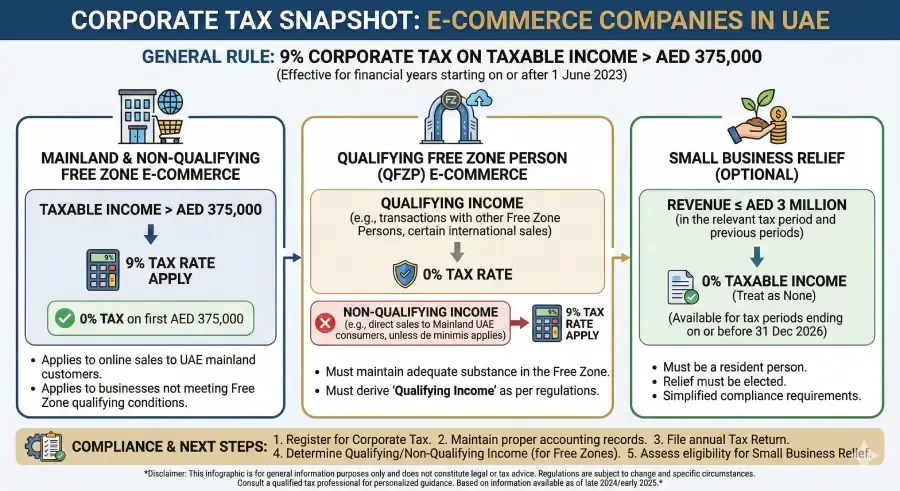
Corporate tax is now a standard part of business planning.
UAE Corporate Tax Basics (E-commerce)
Standard CT rate is 9% (as per the UAE corporate tax framework)
Free Zone entities may qualify for 0% on qualifying income if conditions are met
A key nuance from FTA guidance: a Qualifying Free Zone Person has specific treatment and requirements.
Wings9 insight:
E-commerce businesses often have mixed income streams. If you sell both UAE + international, the tax classification must be designed carefully.
VAT for E-commerce Business in UAE (2026).
VAT is where many online sellers accidentally create penalties.
When VAT Registration Becomes Mandatory
The Federal Tax Authority confirms VAT registration is mandatory when taxable supplies and imports exceed AED 375,000.
The Ministry of Finance also references the VAT registration threshold and voluntary registration threshold.
VAT is Relevant If You:
sell taxable goods/services in the UAE
import goods into the UAE
cross the threshold
operate as a non-resident making taxable supplies (special rule applies)
Pro Tip:
If you sell through Amazon FBA or use UAE fulfilment, VAT planning becomes essential earlier than founders expect.
Payment Gateways & Banking: The Silent Setup Challenge
In 2026, e-commerce businesses face more scrutiny in:
banking approval
merchant account onboarding
payment gateway KYC
Banks may ask for:
supplier invoices
website/store link
product category proof
logistics documentation
source of funds for shareholders
Wings9 operating tip:
Most gateway rejections happen because the licence activity and website category do not match. We align both before submission.
Imports, Customs & Logistics (For Physical Product E-commerce)
If you’ll sell physical goods, your structure should consider:
customs code requirements
import/export permissions
warehousing needs
courier account eligibility
Mainland + certain Free Zones work best depending on:
whether you import into the UAE
whether you drop ship internationally
Whether you use UAE warehouses for GCC shipping
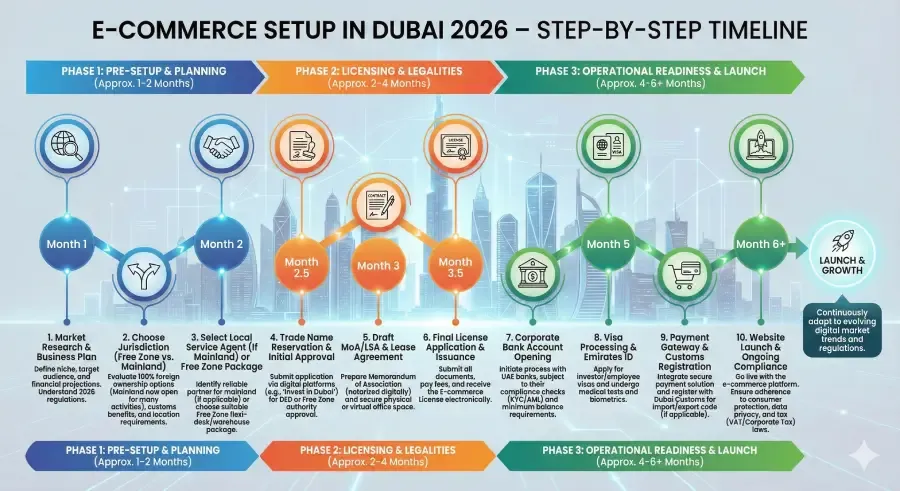
Step-by-Step: E-commerce Company Formation in Dubai (Wings9 Roadmap)
Here’s the process we follow for e-commerce founders:
Step 1: Define your model
products vs services
UAE vs GCC vs global
inventory vs dropshipping
Step 2: Choose jurisdiction
Mainland vs Free Zone
align with customer geography
Step 3: Select activities
This is a critical step. Wrong activity selection causes:
bank rejection
renewal complications
compliance issues
Step 4: Trade name + initial approval
Dubai’s official portals support streamlined processing.
Step 5: Licence issuance
DET licence (mainland) or Free Zone licence
Step 6: Immigration file+visas
Investor visa first
then employees (if required)
Step 7: Bank+payment gateway readiness
KYC file preparation
compliance documentation
Step 8: VAT registration (if applicable)
Once approaching the threshold or imports begin.
FAQ
1) What is the best licence for an e-commerce business in Dubai?
It depends on where your customers are. Mainland suits UAE-focused selling. Free zone suits international and export-driven e-commerce.
2) Can I sell on Amazon and Noon with a Dubai e-commerce licence?
Yes. With the correct trading activity and compliant invoicing structure, you can sell via marketplaces like Amazon and Noon.
3) How much does an e-commerce licence cost in Dubai in 2026?
Costs vary by mainland vs free zone, visas, and office plan. It’s best to calculate the total Year-1 cost (licence + visa + compliance) rather than just package pricing.
4) Do e-commerce businesses need VAT registration in the UAE?
Yes, if taxable supplies/imports exceed AED 375,000. FTA confirms this mandatory threshold.
5) Is corporate tax applicable to e-commerce companies in the UAE?
Yes. Mainland entities fall under standard corporate tax. Free zone entities may qualify for 0% on qualifying income if conditions are met.
6) Can foreigners register an e-commerce company in Dubai?
Yes. Foreigners and NRIs can register companies in both mainland and free zones with 100% ownership in most activities.
7) What’s the biggest mistake new e-commerce founders make in Dubai?
Choosing the wrong licence/activity code and then facing bank/payment gateway issues or having to amend the licence later.
8) Can I run an e-commerce business from Dubai without an office?
Some Free Zones allow flexi desks. The mainland usually requires the Ejari office. Banking may still expect substance depending on your model.
Pillar Page Integration
This guide supports our main resource:
👉 https://wings9.ae/company-formation-in-dubai-2026-mainland-vs-free-zone/
If you're comparing jurisdictions, start there—then use this post to apply the decision specifically to e-commerce.
Wings9 2026 Outlook (What Competitors Aren’t Saying)
Here’s what we’re seeing on the ground:
In 2026, e-commerce success in Dubai will be determined less by “cheap licensing” and more by banking readiness + VAT discipline + cross-border logistics efficiency.
We predict:
more KYC checks for dropshipping models
Greater scrutiny on product categories and invoices
Faster approvals for founders with clean compliance files
Growing demand for hybrid models (Free Zone setup + mainland access strategy)
If you want to scale in the UAE, the best time to set up the correct structure is before you launch.
Ready to Launch Your E-commerce Business in Dubai?
We at Wings9 Management Consultants help founders set up the right e-commerce licence, handle visas, banking support, VAT planning, and compliance—end-to-end.
Start your Dubai journey with Wings9.